Prompt
· English
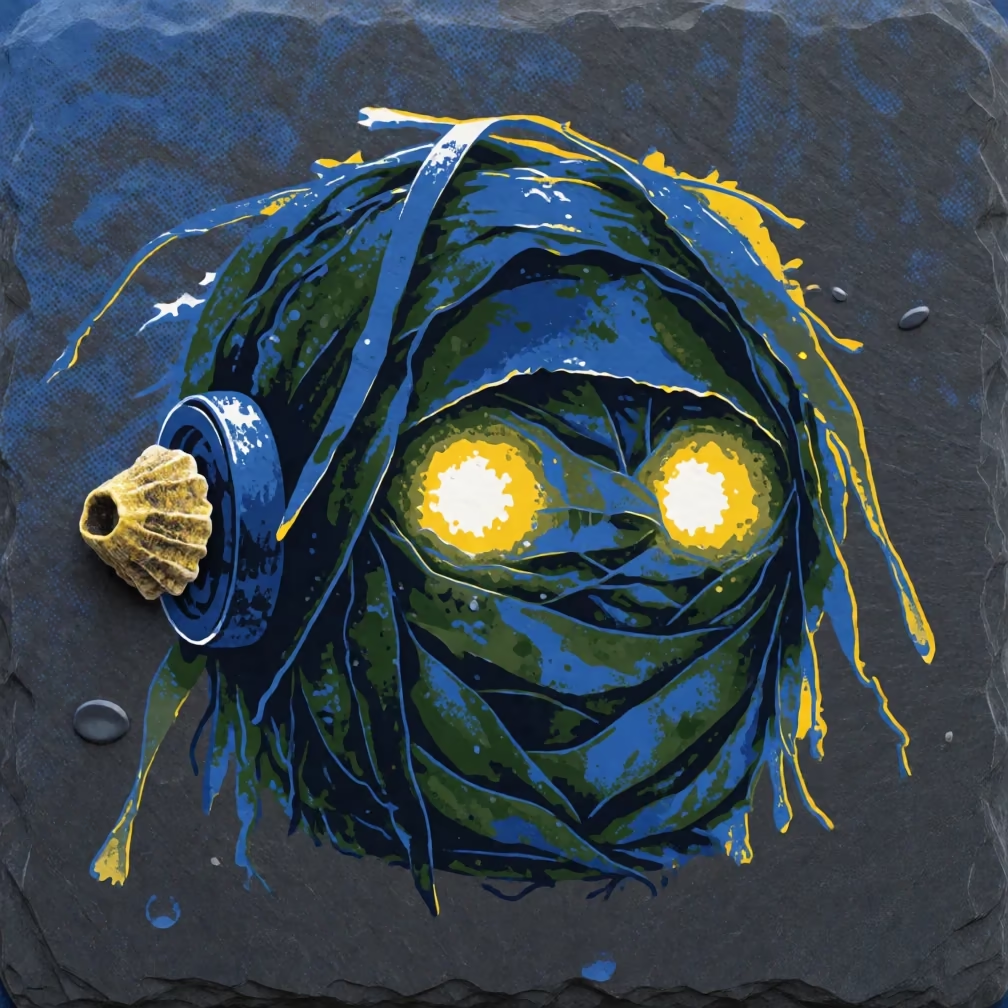
A graphic design featuring a robot head logo crafted from woven sea kelp and dried algae, mounted on a slate stone background, rendered in pure red, yellow and blue with a screen-print texture that includes slight ink misregistration. The robot head is formed from organic, fibrous strands of kelp, which are depicted in shades of deep blue and dark green, though the palette restriction limits the visible colours to the primary triad. The eye sockets emit a bioluminescent glow, represented by bright yellow and white spots that stand out against the dark kelp. The slate background is a flat, dark gray surface that is overlaid with the primary colours in a halftone pattern, creating a gritty, printed look. Frayed edges of the kelp strands are visible as thin, jagged lines that extend beyond the main shape of the robot. A small, dried barnacle is attached to the robot's left ear, depicted as a rough, yellowish lump that contrasts with the smoothness of the kelp. Moisture condensation on the slate surface is suggested by small, blueish droplets scattered across the background. The composition is centered, with the robot head occupying the majority of the frame. The screen-print texture is evident in the way the colours overlap and fail to align perfectly, creating a sense of depth and imperfection. The final image is a bold, graphic piece that combines natural organic forms with a rigid, industrial palette, resulting in a striking visual contrast.
This prompt works by imposing a strict, primary colour palette on a natural, organic subject. The 'pure red, yellow and blue' constraint forces the model to interpret the kelp and slate through a limited lens, creating a bold, poster-like aesthetic that is distinct from the typical realistic or muted nature designs.
- Subject
-
robot head logo crafted from woven sea kelp and dried algae bioluminescent glow emanating from its eye sockets These words define the unique material of the logo and its key active feature, the glow.
Change: replace sea kelp with dried twigs — the logo becomes terrestrial and woody, losing the aquatic, bioluminescent context.
- Scene
-
slate stone background frayed edges of the kelp strands small dried barnacle moisture condensation These details ground the logo in a specific physical environment, adding texture and narrative to the graphic.
Change: replace slate stone with wooden plank — the background becomes warmer and more rustic, changing the industrial feel of the slate.
- Framing
-
pure red, yellow and blue screen-print texture with slight ink misregistration centered These framing instructions dictate the style and composition, ensuring the image has a bold, graphic quality.
Change: replace pure red, yellow and blue with full spectrum colours — the image becomes more realistic and less stylized, losing the poster-like impact.
- Light
-
bioluminescent glow bright yellow and white spots In this graphic design, light is represented by the glow effect, which acts as the primary light source for the subject.
Change: replace bioluminescent glow with reflective metallic sheen — the light source changes from internal energy to external reflection, altering the mood.
- Style
-
screen-print texture halftone pattern bold, graphic piece These terms describe the physical properties of the print, guiding the model to create a textured, imperfect look.
Change: replace screen-print texture with smooth digital gradient — the texture is lost, resulting in a cleaner, more modern look.
- Variations
-
- replace
bioluminescent glow with red laser eyes — the glow becomes sharper and more aggressive, changing the robot's personality.
- replace
woven sea kelp with torn paper — the material becomes abstract and man-made, losing the organic connection to nature.
- replace
slate stone with black asphalt — the background becomes urban and rough, shifting the context from nature to city.